
Sodium bicarbonate has a pH of 8.3, far too alkaline for underarm skin (pH 4.5 to 5.5). That pH gap disrupts the skin's hydrolipidic film and causes redness, itching and sometimes lasting irritation on sensitive skin. Actives such as magnesium hydroxide and triethyl citrate neutralise odour without that risk.

Magnesium hydroxide and organic calendula. No baking soda, no aluminium, no alcohol.
You wanted to switch to natural deodorant , and your underarms reacted badly. Redness, burning, patches that wouldn't go away. You gave up, concluding that "natural doesn't work for me".
Before you give up : did you check whether your deodorant contained baking soda ?
Why does baking soda irritate sensitive skin?
The pH problem
Underarm skin has a natural pH between 4.5 and 5.5, slightly acidic, which is its first barrier against bacteria and irritation. Sodium bicarbonate (NaHCO₃) has a pH of 8.3, which is nearly 1000 times more alkaline than skin.
Applied daily to an area as thin and sensitive as the underarm, especially after waxing or shaving, that pH gap disrupts the skin's hydrolipidic film over time. The skin loses its ability to defend itself, and the reactions appear : redness, itching, and in the long run even hyperpigmentation.
Irritation or allergy?
What most people experience is not an allergy to baking soda , it's a contact irritation, gradual and cumulative.
It can appear from the very first application, or after several weeks of regular use. It's all the more common when the skin is thin, shaved or already fragile.
Baking soda is the ingredient most often involved in reactions to natural deodorants. It's a chemical irritation, not an allergy , and that distinction matters if you want to understand why it affects so many different skin types.

What replaces baking soda in an effective natural deodorant?
The good news: baking soda is not irreplaceable. Two actives neutralise body odour without the harshness.
Magnesium hydroxide
Magnesium hydroxide (Mg(OH)₂) is a natural mineral that works by neutralising the bacteria responsible for odour. The bacteria that break down sweat and produce odour molecules need a slightly acidic environment to thrive.
Magnesium hydroxide disrupts that environment at the surface, without blocking perspiration and without penetrating the pores.
Unlike baking soda, it doesn't disturb the skin's pH in any lasting way , its action is local and targeted. It is tolerated by the most sensitive skin, including during pregnancy and breastfeeding.
Triethyl citrate
Triethyl citrate (INCI: Triethyl Citrate) is a naturally derived deodorant active, made from citric acid.
Its mechanism has been documented by Jungbunzlauer, its main manufacturer: triethyl citrate inhibits the lipase enzymes produced by skin bacteria. Without those enzymes, the bacteria can't break down the lipids in sweat into volatile fatty acids, and it's precisely those fatty acids that create body odour.
The result: odour is neutralised at the source, without altering the skin microbiome.

Is a baking soda free deodorant really effective?
That's the key question, and a fair one.
The answer depends on something often misunderstood: the difference between a deodorant and an antiperspirant.
An antiperspirant (based on aluminium salts) physically blocks the sweat glands to reduce perspiration. A natural deodorant doesn't block perspiration at all, it neutralises the bacteria and the odour molecules. Both approaches work against odour, but the mechanism is fundamentally different.
If you expect a natural deodorant to stop perspiration completely, you'll be disappointed, that isn't its job. If you expect it to neutralise odour all day, a well formulated deodorant with magnesium hydroxide and triethyl citrate can do exactly that.
Switching from an antiperspirant to a natural deodorant, step by step
It's the question I'm asked most often. You don't need a « detox »: you just need to know what to expect and to pick a formula your skin tolerates.
- Expect to sweat again. An antiperspirant blocks sweat with aluminium salts; a natural deodorant lets it through and only neutralises odour. You will notice the difference in the first few days: that's normal, not a failure.
- If your skin is reactive, pick a baking soda free formula. It's the ingredient most often behind redness, as explained above.
- Apply to clean, completely dry skin. Two or three strokes are enough: moisture reduces effectiveness.
- After shaving or waxing, wait until the skin is fully dry before applying.
- Judge it over a few weeks, not on the first heatwave day.
- If your skin turns red, stop and reread the label using the list below. If the irritation persists, ask your pharmacist or doctor.
Ingredients to avoid if your skin is reactive
- SODIUM BICARBONATE (baking soda): highly alkaline, it's the number one cause of irritation from natural deodorants.
- ALCOHOL DENAT. near the top of the list: it dries and stings, especially on shaved skin.
- Fragrance and essential oils (PARFUM, and allergens such as LINALOOL, LIMONENE, GERANIOL, CITRAL): if you react easily, choose an unscented version.
- Aluminium salts (ALUMINUM CHLOROHYDRATE, ALUMINUM ZIRCONIUM...): they are what makes an antiperspirant. If you want to do without, they shouldn't be on the list.
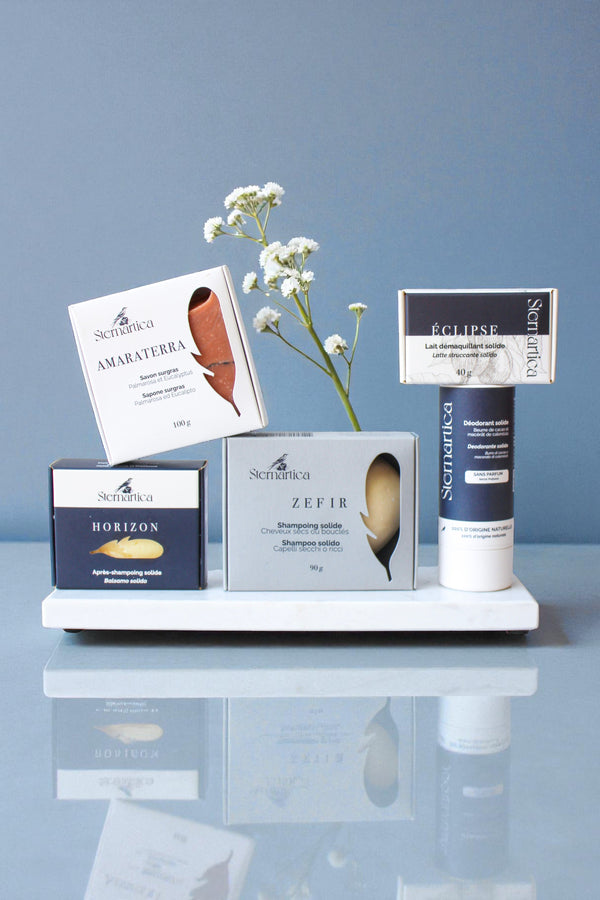
My solid deodorant comes in an unscented version for exactly this reason. Its list has six ingredients: cocoa butter, magnesium hydroxide, triethyl citrate, rice bran wax, sunflower oil and calendula.
To compare the natural deodorants on the market against these criteria, I put five of them side by side in my natural deodorant comparison.