
Two years ago a customer wrote to me: « I have tried three shampoo bars, my hair came out waxy every time. I give up. »
She had not chosen badly. She had bought the same type of product three times over without knowing it, and that type did not suit her hair.
That is almost always what sits behind a bad review of a shampoo bar. Not a bad product: a product that was not made for that hair, or that was not a shampoo at all.
Why so many bad reviews?
Three causes come up again and again, and none of them is « solid just doesn't work ».
- It was not a shampoo, it was a soap. Many bars sold as shampoo bars are saponified soaps: excellent for the body, but with a pH around 9. Hair lives around 5. The result: open cuticles, rough hair, that film that never quite rinses away.
- The shampoo did not match the hair type. A bar formulated for dry hair, used on oily hair, gives heavy roots within two days. The other way round leaves lengths that feel scratchy. Solid is more specialised than liquid, not less.
- The technique was wrong. People rub the bar along the lengths instead of lathering it in their hands and massaging the scalp. They rinse too little. That is two minutes to relearn, not a revolution.
I went into the first case, the most common one, in a separate article: waxy hair with a shampoo bar, the real cause.
Soap or real shampoo: the difference that changes everything
This is the point almost no review mentions, and it is the one that decides everything.
A soap is made by saponification: oils and a strong base. Its pH is alkaline by nature, and you cannot bring it down without destroying the soap.
A shampoo bar is built around a gentle surfactant. The most common one in carefully made formulas is sodium cocoyl isethionate, derived from coconut oil: it lathers, it cleans, and it allows a formula whose pH suits hair.
| Saponified soap | Shampoo bar | |
|---|---|---|
| First INCI ingredient | Sodium Olivate, Sodium Cocoate… | Sodium Cocoyl Isethionate |
| pH | around 9 | suited to hair |
| On the lengths | open cuticles, rough to the touch | smooth fibre |
| « Transition period » | often needed | none |
The 4 things to check before you buy
- ✓The first ingredient. The INCI list runs in decreasing order: the first name is the base of the formula, and it decides everything else.
- ✓Whether it contains sulfates. SLS and SLES clean very efficiently, sometimes too efficiently on a sensitive scalp, curly hair or coloured hair. It is not a poison, it is a question of fit.
- ✓Which hair type it is made for. A bar that claims to suit everyone deserves a second read. Formulas that work are targeted.
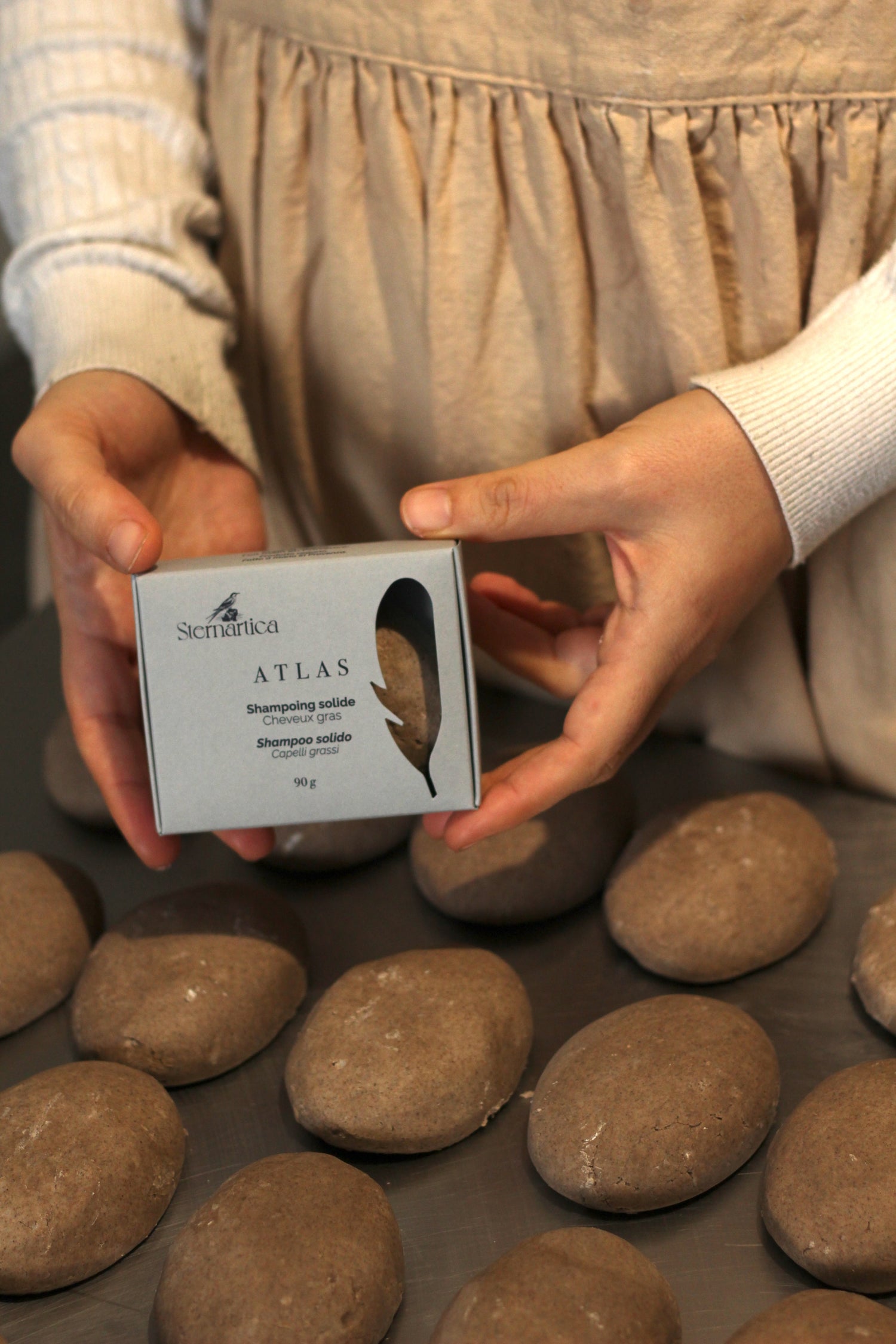
- ✓How many ingredients are genuinely certified organic. « Natural » means nothing in law. « Organic » is certified, and it can be counted: here, 9 out of 10 for Neptune, 8 out of 9 for Zefir, 7 out of 10 for Atlas. A maker who does not give you that figure has a reason.
Comparison: 4 shampoo bars side by side
I make shampoo bars, so I am not neutral. Rather than telling you mine are the best, I noted the same criteria for three brands people often mention to me, straight from their own websites, on 21 October 2026. Every row links to its source, so you can check everything.
| Shampoo bar | Cleansing agent | Organic, as stated | Price | Stated lifespan |
|---|---|---|---|---|
| Sternartica MineNeptune, all hair types | Sodium Cocoyl IsethionateSulfate-free | 9 ingredients out of 10 | €14.9090 g, i.e. €16.56 per 100 g | Up to 60 washes |
| LamazunaNutri Glow, normal hair | Sodium Cocoyl IsethionateSulfate-free | 19% of total ingredients | €10.9070 ml | 2 months |
| UnbottledTous types de cheveux, sweet almond | Sodium Cocoyl IsethionateSulfate-free | Not stated | €12.9075 g, i.e. €17.20 per 100 g | 2 months |
| EndroCheveux normaux | Sodium Coco-SulfateContains sulfate | 18% of total ingredients | €7.9080 ml | 30 to 40 uses |
My takeaway. None of these four bars is a soap: all four are real shampoos. Three are built on the same gentle, sulfate-free surfactant, sodium cocoyl isethionate. Endro chose a coconut-derived sulfate: it cleans very well, but for a sensitive scalp, curls or coloured hair I would pick a sulfate-free formula.
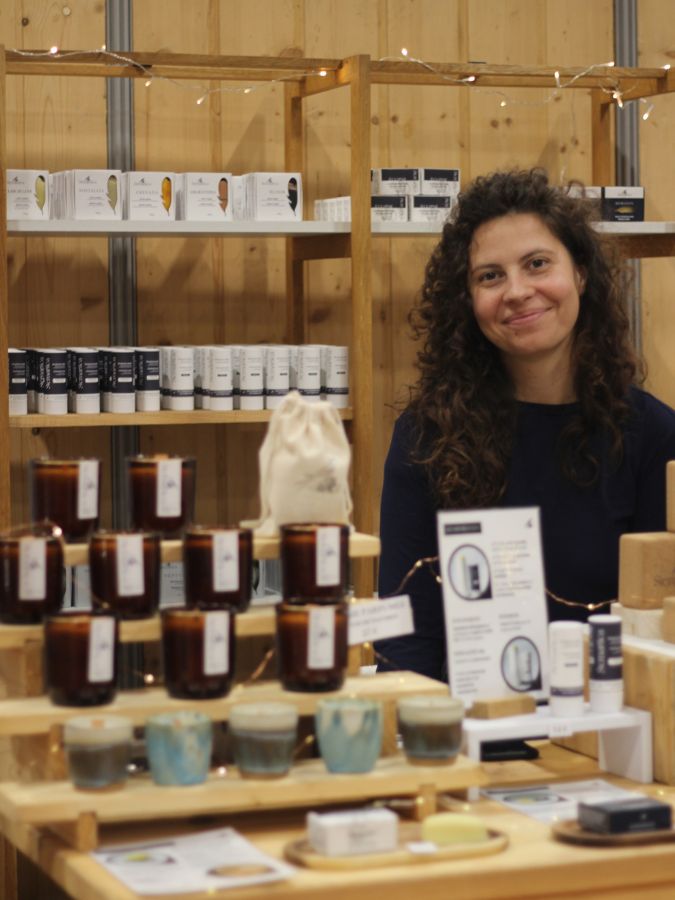
What makes the difference with Neptune. It's the heaviest bar among those that state their weight: 90 g, against 75 g for Unbottled. Per 100 g it comes to €16.56, cheaper than Unbottled (€17.20). It gives up to 60 washes, against 30 to 40 uses for Endro. Nine of its ten ingredients are certified organic, it's rated Excellent on Yuka, and I mould it by hand, one by one, in my workshop in Drôme Provençale.

90 g bar, up to 60 washes, sulfate-free, rated Excellent on Yuka, hand-moulded in Drôme Provençale. Free shipping from €40, a gift in every order, 4.97/5 from 155 verified reviews.
Good to know, to be complete. Neptune contains two essential oils, clary sage and mandarin, and I recommend it from age 3; Lamazuna and Unbottled, in these versions, have none. Endro is still the cheapest to buy.
A word on the organic column: brands do not all count the same way. Some give the share of the formula, others the number of certified ingredients. The two figures cannot be compared directly, which is why I copy them as stated. Prices and formulas noted on 21 October 2026 on the brands' websites; they may have changed since.
Is a « transition period » necessary?
You read everywhere that you have to endure three to six weeks of dull hair while your scalp rebalances.
A properly formulated shampoo bar needs no transition period. What people take for a transition is usually an alkaline bar leaving a deposit at every wash. If your hair still feels unpleasant after three weeks, the problem is not your scalp: it is the product.
Which one to choose for your hair
Our three shampoos are shaped by hand in my workshop in Drôme Provençale, around the same gentle sulfate free surfactant, each with a different active depending on the need. One bar replaces four 250 ml bottles: up to 60 washes. All three are rated Excellent on Yuka.