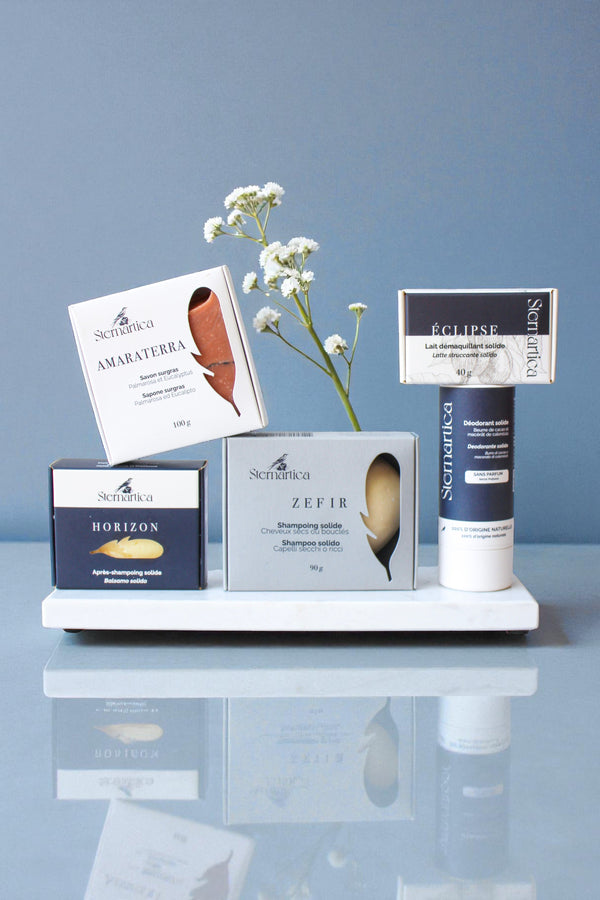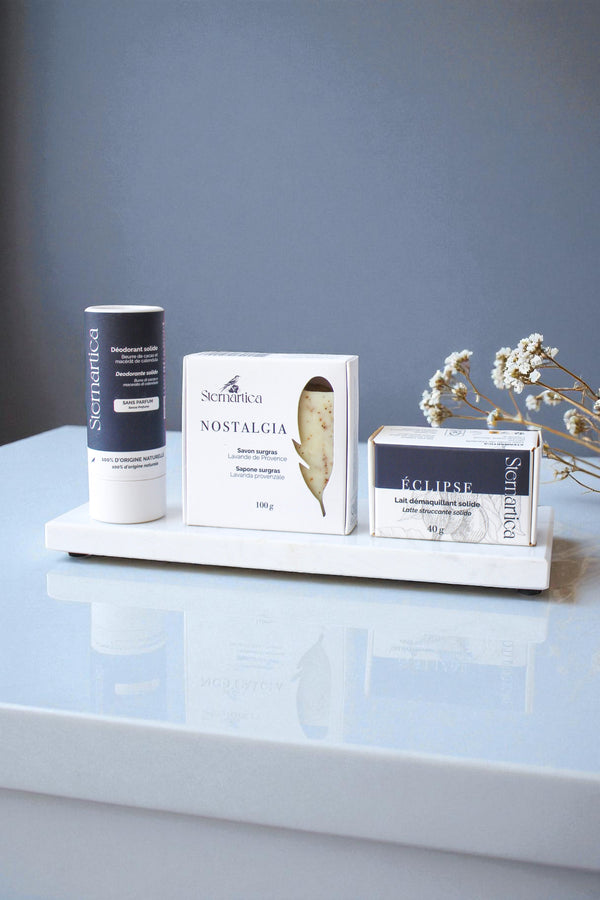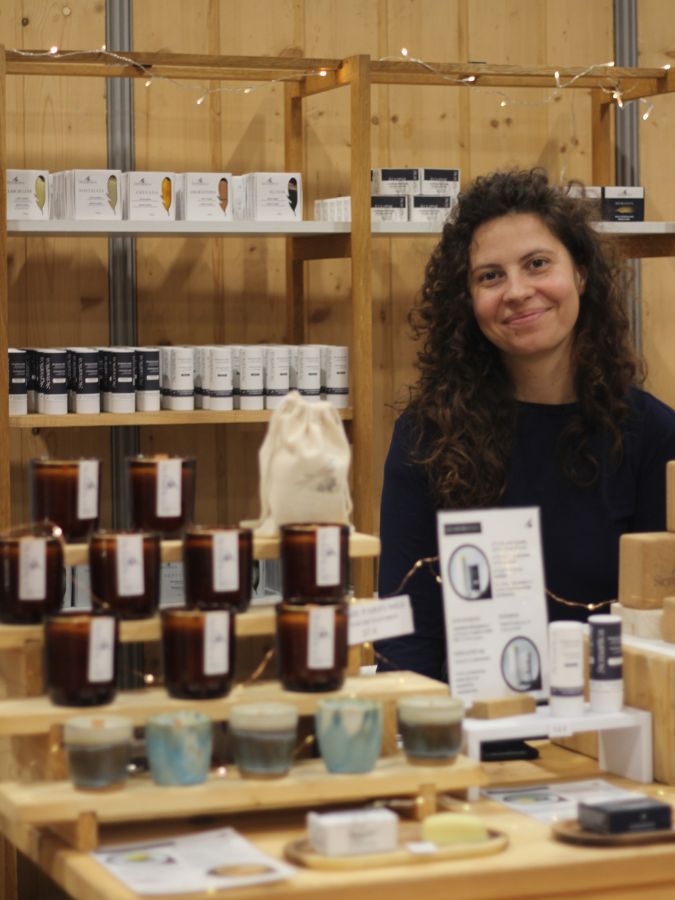

Cold process saponification mixes vegetable oils and lye at room temperature, which leaves the glycerine, a natural humectant, inside the bar. Industrial soaps strip that glycerine out to sell it separately, which is why your skin feels tight after a shower. Every Sternartica soap is cold processed by hand in Drôme Provençale, with a cure time of at least 8 weeks.

One superfatted soap per skin type, poured and cut by hand in my workshop in Drôme Provençale.
You buy a "natural" soap at the supermarket, and your skin feels tight two minutes after the shower. You try an artisan cold process soap, and for the first time you don't need body lotion straight afterwards.
That difference isn't luck. It has a precise chemical explanation, and understanding cold process saponification means understanding why your soap does what it does to your skin.
What is cold process saponification?
Saponification is the chemical reaction that turns fats (oils, vegetable butters) into soap. It happens in the presence of lye (sodium hydroxide, NaOH). In the cold process, that reaction takes place at room temperature , or barely warm, never heated. That has two important consequences:
-
✓The glycerine stays in the soap. Saponification naturally produces glycerine as a by-product. In an artisan cold process soap it stays in the bar. Glycerine is a powerful natural humectant: it attracts and holds moisture on the skin.
-
✓Heat sensitive ingredients are preserved. Essential oils, plant extracts and fat soluble vitamins (vitamin E, beta-carotene) degrade under heat. In cold process saponification they keep their integrity and their properties.
After it is made, the soap is left to dry for at least 8 weeks. That cure time is essential: it lets the chemical reaction complete, the water evaporate and the bar harden. A well cured soap lasts longer and is gentler on the skin.

What happens in an industrial soap?
Industrial soap starts from a different premise: profitability first. Most supermarket "soaps" are made from soap noodles , an already saponified base, often from palm oil or animal fats, bought in bulk. To that base are added synthetic surfactants (SLS, SLES), preservatives, colourants and synthetic fragrances.
Above all: the glycerine produced during saponification is removed. It's worth more than the soap itself, so it is sold on to make lotions, creams and other cosmetics. The soap is left without its main natural moisturising agent.
The result is a product that cleans effectively but leaves skin tight, dried out, sometimes irritated. And then you need a cream. That's how the industry sells two products where one would do.
The comparison, point by point
| Cold process | Industrial soap | |
|---|---|---|
| Glycerine | Stays in the bar | Often separated and sold on |
| Temperature | No cooking, worked at low temperature | Worked hot |
| Superfat | Part of the oils stays unsaponified | Rare, agents are added afterwards |
| Time | At least 8 weeks of curing before sale | A few hours from paste to wrapper |
| Ingredient list | Short, every line is recognisable | Longer, with surfactants and fillers |
| Batch size | Small batches, bar by bar | Continuous production |
What changes in the shower
A cold-process soap gives a denser, less abundant lather: lather is not a measure of cleaning, it depends on the surfactants. It leaves the skin feeling less tight, because the glycerine and the unsaponified oils stay where they are.
It is also softer to the touch and takes up water more easily. That is why it needs to dry between uses, otherwise it wears down fast.
Cold process soaps by Sternartica
5 skin types · natural glycerine preserved · handmade in Provence

Why cold process is better for your skin
Three concrete reasons:
-
1The natural glycerine stays in the bar. It moisturises your skin while you wash, not only afterwards. Dry, mature and sensitive skin feels the difference immediately.
-
2The plant actives are intact. A kaolin clay soap doesn't just "contain" kaolin for the label, the clay is really there and really working in the formula. The same goes for essential oils, butters and plant extracts.
-
3The ingredient list is readable. In cold process saponification each oil becomes its SODIUM [OIL NAME]ATE equivalent on the INCI: SODIUM OLIVATE for olive oil, SODIUM COCOATE for coconut oil, SODIUM SHEA BUTTERATE for shea butter.
If you see SODIUM LAURYL SULFATE or SODIUM LAURETH SULFATE at the top of the list, you're not looking at a real saponified soap, you're looking at a syndet, a detergent bar.
How to recognise a genuine cold process soap
Read the INCI list. The good signs:
-
✓Entries in the form SODIUM + [OIL NAME]ATE (SODIUM OLIVATE, SODIUM COCOATE, SODIUM CASTORATE…)
-
✓GLYCERIN among the ingredients (a sign it stayed in the formula)
-
✓Recognisable oils, butters and plant extracts in the list, Cosmos Organic or Cosmos Natural certification
The warning signs:
-
✕SLS, SLES or Cocoamidopropyl Betaine at the top of the list
-
✕A long ingredient list full of obscure chemical names
-
✕The words "toilet bar" or "syndet" in the product details
These signs are enough to rule out an industrial soap. To decide between two genuine cold process soaps (superfat, organic share, labels, palm oil), I compared four bars label by label in my guide on how to choose the best cold process soap.