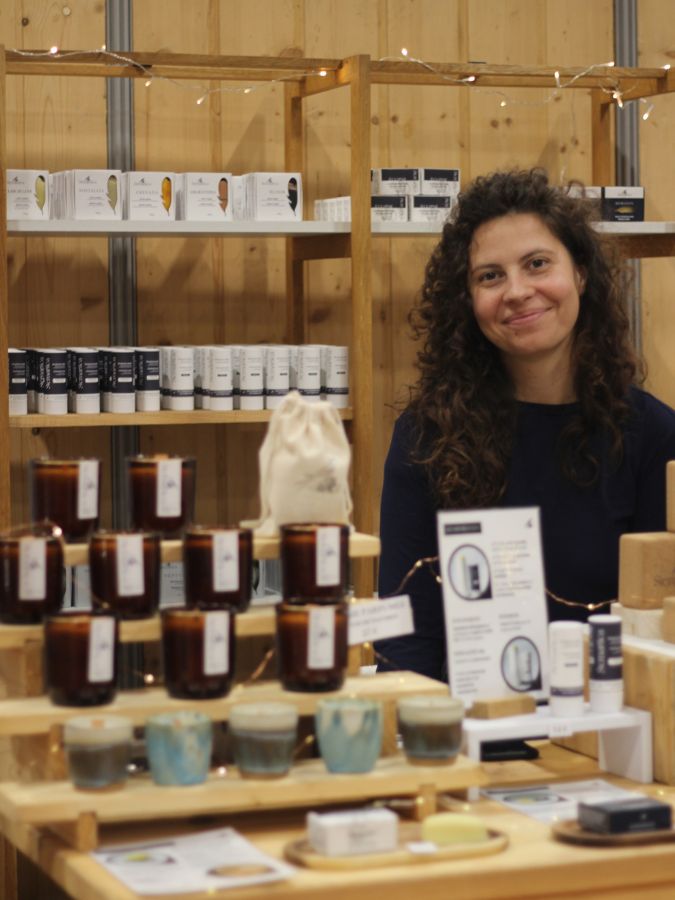

Sunflower wax burns cleaner than paraffin, a petroleum-refining byproduct: less soot, more even fragrance diffusion, longer burn time. Sternartica makes its candles with plant-based, European-grown sunflower wax, fragrances crafted in Grasse without phthalates or CMR substances, and a cherry wood wick: 70 hours of clean light, no compromise.

Sunflower wax, a cherry wood wick and a perfume from Grasse. 70 hours of clean burning.
You light a candle to create an atmosphere, not to breathe in a petroleum byproduct. Yet the vast majority of candles sold in supermarkets are made from paraffin, a byproduct of oil refining. That's not written anywhere in bold on the label.
It's not an immediate poison. But what you let burn for hours in your living room deserves a closer look. Here's what we learned making our own candles with sunflower wax, in our workshop in Drôme Provençale.
Why is paraffin still in most candles?
Paraffin is a solid byproduct obtained from refining crude oil. It's cheap, easy to mould and easy to scent, which explains its massive presence in the candle industry for over a century.
The issue isn't that it's dangerous after one use. The issue is three cumulative effects:
- A less clean burn: more visible soot on the glass and, over time, on nearby walls.
- Sometimes uneven burning: the candle "tunnels" in the centre instead of melting evenly to the edges.
- Emissions linked to oil refining: volatile organic compounds (VOCs) whose quantity varies with the quality of the paraffin used.
To be fair: the intensity of these emissions mostly depends on the paraffin's quality and the room's ventilation. It's not an immediate hazard comparable to other indoor pollution sources. But why accept that trade-off when a plant-based alternative exists, at equal fragrance quality?

What is sunflower wax, and why does it burn better?
Sunflower wax is obtained by hydrogenating sunflower oil: a renewable, biodegradable, vegan plant-based wax. Its burning characteristics differ from paraffin on three concrete points:
-
✓A cleaner burn
Less soot, glass that doesn't blacken, almost invisible smoke when extinguished. -
✓More gradual fragrance diffusion
Plant wax releases fragrance more evenly across the whole burn, instead of an early peak that fades out. -
✓A longer burn time
Our 270 g Sternartica candles offer around 70 hours of burn time, provided the wax is left to melt to the edges each time.
Sternartica Scented Candle
Sunflower wax · 270 g · 70h burn time · €29.00
Sunflower wax vs soy wax: which one wins?
Soy wax has long held a monopoly on the "clean plant wax" image, often rightly so, but not always for solid traceability reasons.
Global soy is grown at very large scale in the Americas
Most of the world's soy is grown on vast areas across North and South America, production sometimes linked to deforestation and largely dominated by GMO crops. That's not systematically the case for soy wax used in cosmetics or candles, but traceability back to the original field is rarely documented.
Our sunflower wax comes from European crops, which shortens the supply chain and makes traceability easier.
-
✓No distant deforestation linked to cultivation
-
✓European supply chain, shorter and more traceable
Candle fragrance: the detail nobody checks
Even a plant-wax candle can disappoint if its fragrance is poorly formulated. Some cheap synthetic fragrances contain phthalates or other CMR substances (carcinogenic, mutagenic, reprotoxic), now strictly regulated in Europe but not always absent from imported candles.
Our fragrances are crafted in Grasse, the world capital of perfumery, following IFRA (International Fragrance Association) standards, free of phthalates and CMR substances.